
Fore Hadley & Children’s Hospital of Philadelphia
April 2026 - Research Update from our Friends at CHOP
Executive Summary
Genomic Contributors to Congenital Diaphragmatic Hernia (CDH)
Overview
This study represents one of the largest genomic analyses of congenital diaphragmatic hernia (CDH) to date, evaluating the genetic underpinnings of the condition through exome sequencing (ES) in 560 patients and comparison with an independent genome sequencing (GS) cohort. The objective was to quantify diagnostic yield, identify causative and candidate genes, and better understand the molecular basis of CDH across both complex/syndromic and isolated/non-syndromic presentations.
Key Findings
1. High Diagnostic Yield of Genetic Testing
A reportable genetic finding was identified in 61% of patients overall.
Yield was higher in:
Complex/syndromic CDH: 64%
Isolated/non-syndromic CDH: 56%
Approximately 48% of cases had variants considered causative or possibly associated with CDH.
Implication: Genetic testing—particularly broad sequencing—has substantial clinical value across all CDH cases, including those previously considered “isolated.”
2. Broad Genetic Heterogeneity
Variants were identified across 345 genes, highlighting significant genetic diversity.
Many genes were:
Previously known contributors
Newly implicated or candidate genes
Only a subset showed strong recurrence across multiple patients, suggesting complex, multi-gene involvement rather than a single dominant pathway.
3. Stronger Signal in Recurrent Genes
A focused analysis of 73 genes found in multiple patients showed:
Significantly higher variant burden in CDH vs. control cohort (neural tube defects)
Strong statistical association with CDH (p < 0.001)
These genes were enriched for pathways involving:
Transcriptional regulation
Chromatin remodeling
Developmental signaling pathways
Implication: Recurrently mutated genes are likely central to CDH pathogenesis and represent high-priority research targets.
4. Overlapping and Networked Biology
Key genes (e.g., MYRF, ZFPM2, GLI2/3, CREBBP) were identified across cohorts.
Network analysis (see figures on pages 5–6) demonstrates:
Extensive protein–protein interactions
Clustering around developmental and regulatory pathways
Implication: CDH is driven by interconnected gene networks, not isolated mutations.
5. Expanded Understanding of “Isolated” CDH
Historically, isolated CDH had low genetic detection rates (<5%).
This study found substantially higher detection (56%), suggesting:
Many “isolated” cases may have underlying genetic drivers not clinically apparent
Broader testing criteria are warranted
Clinical & Strategic Implications
Routine genomic testing should be considered standard of care for all CDH patients
Genetic findings can:
Improve prognostication and risk stratification
Inform clinical management and long-term monitoring
Enable genetic counseling for families
Identification of candidate genes opens pathways for:
Targeted research
Potential future precision therapies
Limitations
Retrospective design and heterogeneous cohorts
Variability in phenotype classification and testing timing
Many variants remain uncertain or non-causal, requiring further validation
Bottom Line
This study reinforces that CDH has a strong and complex genetic basis, with high diagnostic yield achievable through modern sequencing. The findings support broad adoption of genomic testing, highlight key gene networks involved in diaphragm development, and lay the groundwork for future precision medicine approaches in CDH care.
In 2020 with primary support Locumtenens.com the Fore Hadley Foundation engaged with the team at Children’s Hospital of Philadelphia to assist in their ongoing search for genetic markers that may help identify instances of non-syndromic (isolated) congenital diaphragmatic hernia - in other words, cases where other genetic abnormalities like Cornelia de Lange Syndrome (CdLS) and Pallister Killian Syndrome (PKS) are not present.
Funds from Fore Hadley went primarily towards the provisioning of Genomic Sequencing (DNA) for ~ 25 tissue samples and assisted in the requisition of the necessary tissue procurement and processing on which testing could be done.
Breakdown of the Genomic Sequencing Study:
25 Human DNA Samples over the course of 2 years
$1,500/sample for DNA Sequencing
$600/sample for RNA Sequencing
Summarized Findings:
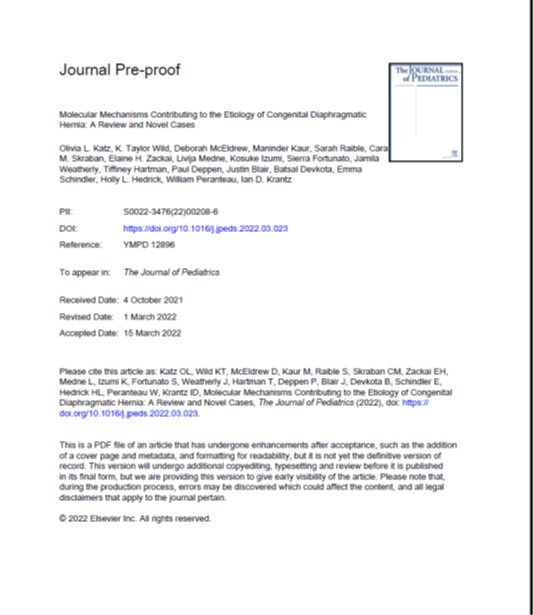
The research team at CHOP identified two novel genes - STAG2 and MED14 - they believe may have substantial impact on the presentation of isolated cases of congenital diaphragmatic hernia. Neither of these genes had previously been noted or understood to have an impact on CDH, however through this initial research and subsequently the paper below being published in The Journal of Pediatrics they plan to expand their study via grant applications to the likes of the National Institutes of Health (NIH) to further study these genes. In their own words:
Identifying an underlying genetic etiology of CDH helps to alleviate feelings of parental guilt facilitates more accurate counseling about prognosis, as well as recurrence risks, both for the family in future pregnancies, and eventual transmission risk for the patient (something that will be of particular importance as more and more children with CDH are surviving to adulthood and reproducing), improves understanding of the pathophysiology of CDH and possible genotype-phenotype correlations and leads to opportunities for developing novel therapeutic approaches, which will likely be gene and variant specific. This is important in the era of fetal interventions such as gene editing; the ability to target aberrant genes during development to facilitate proper diaphragm formation could have far reaching benefits on a fetus found to have CDH at an early point in pregnancy.